
Why Bail Bond Agencies Should Treat SB 1325 as a Business Signal
When a state moves from discretionary GPS to a structured mandate for a high-liability offense class, two things happen almost every time: courts tighten release conditions, and defendants need a supervised pathway that someone must operationalize. Bail bondsmen who post bond for domestic violence defendants are already on the hook for appearance and compliance optics. SB 1325 reinforces that bail monitoring is not optional window dressing—it is part of the release package the public and the bench expect to see enforced.
Agencies that already bundle or refer bail monitoring gain a clearer revenue line: monitoring fees (often passed through to the defendant under statutes like Oklahoma’s defendant-pays framing) can offset operational risk. Agencies without a bail monitoring partner are exposed—when the court orders GPS, scrambling for a vendor at intake slows releases and strains relationships with attorneys and clerks. Forward-looking shops are formalizing bail monitoring agreements now so intake staff know exactly which GPS ankle monitor inventory, software login, and alert escalation path to use before the defendant walks out.
Revenue, Compliance, and Liability: The Triad
Bail monitoring partnerships can be structured as referral fees, per-diem supervision, or equipment lease-to-own models. Each model changes who holds first-line responsibility when an alert fires at 2 a.m. The unanimous vote on SB 1325 signals bipartisan appetite for victim safety tooling; that political consensus usually translates into stricter audit questions after any high-profile breach. If your bail monitoring stack cannot prove chain-of-custody on the GPS ankle monitor, document tamper events, and show that victims and agencies were notified per program rules, the bond agency’s brand can be dragged into the headline even when the fault lies upstream.
Treat pretrial electronic monitoring for DV cases as a higher standard than generic check-in apps. Victim proximity logic, exclusion zones around protected addresses, and rapid law enforcement notification are not “nice-to-haves” for domestic violence GPS monitoring—they are the reason the bill exists. Your contracts should spell out which party owns alert response, how quickly someone must acknowledge a breach, and what evidence is preserved for court review.
What Bail Agencies Need to Know: Equipment and Cost Structure
Courts and pretrial administrators evaluating domestic violence GPS monitoring programs typically look for a short list of capabilities: live or near-real-time location, geofence and exclusion-zone logic, redundant tamper signaling, and a documented path for victim notification. Under SB 1325’s direction, defendants bear device and supervision costs—similar in spirit to other user-funded pretrial electronic monitoring models—which means your client-facing fee schedule and disclosure documents need to be airtight. Confusion about who pays what erodes trust faster than a missed court date.
| Requirement | Why DV dockets care |
|---|---|
| Continuous GPS track | Supports exclusion zones and approach alerts central to domestic violence GPS monitoring |
| High location precision | Reduces false “near victim” flags that waste officer time and retraumatize survivors |
| Tamper detection | Strap and case integrity signals must be trustworthy for prosecutors and victims’ advocates |
| Multi-channel alerts | Law enforcement and victim notification paths must match each court’s order |
| Defendant-funded billing | Transparent invoices support compliance with defendant-pays statutory language |
When you compare any GPS ankle monitor for DV workloads, ask vendors for written SLAs on alert latency and data retention. A GPS ankle monitor that drops offline in apartment complexes or shopping centers will generate either dangerous blind spots or noisy false alarms—both are unacceptable in domestic violence GPS monitoring contexts. The same diligence applies if you white-label pretrial electronic monitoring services: your brand rides on hardware you did not manufacture, so test devices in urban canyons and typical residential layouts before you standardize.
Technology Bar: Accuracy, Tamper Integrity, and Court Confidence
Proximity alerts for protected persons only work if the underlying position fix is stable. Sub-2m accuracy helps ensure victim notification is tied to genuine boundary breaches rather than scatter from poor satellite geometry—reducing false alarms that erode court confidence and officer patience. Fiber-optic tamper paths that avoid chronic false tamper storms also keep supervisors focused on real risk instead of chasing phantom strap alerts.
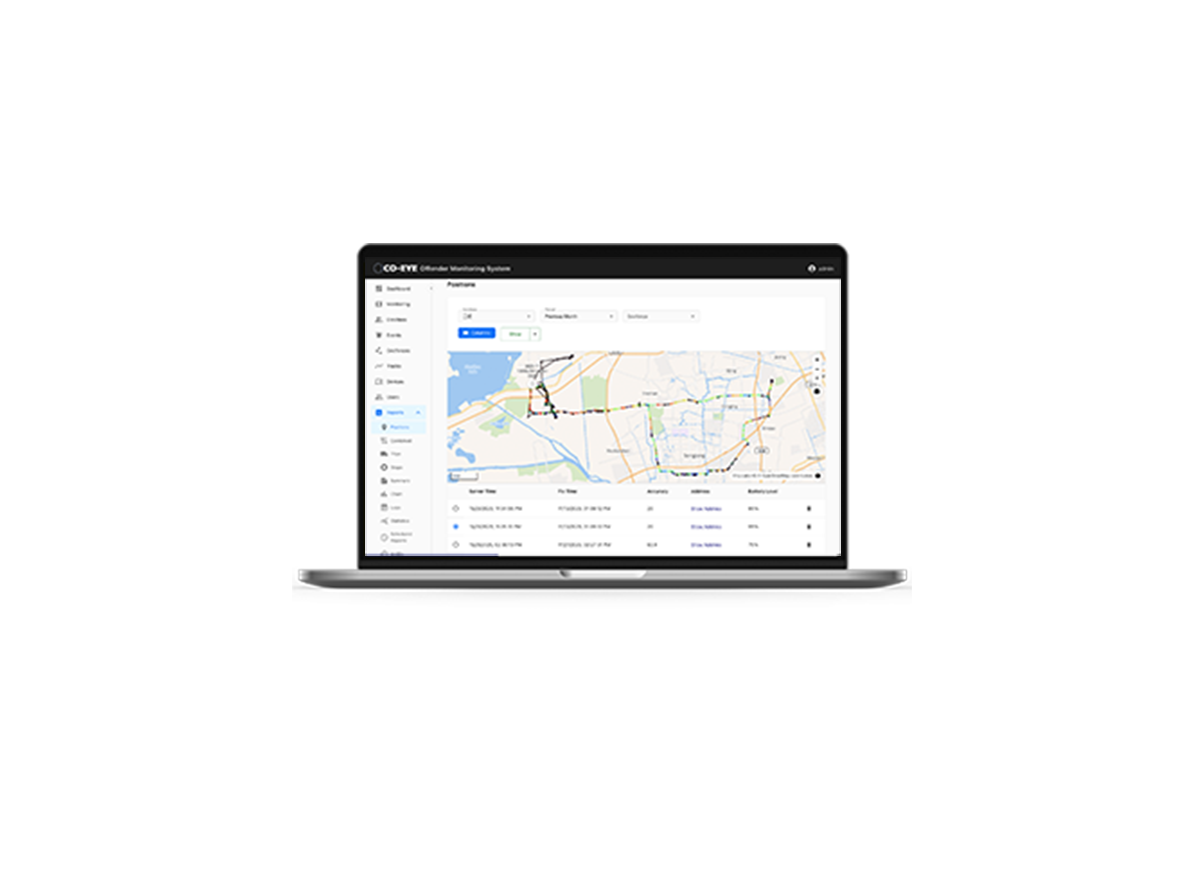
Modern one-piece GPS monitors like the CO-EYE ONE offer fiber-optic tamper detection and continuous tracking that DV monitoring demands. These GPS ankle monitor designs align with what many domestic violence GPS monitoring programs expect from hardware placed on high-risk caseloads. Pairing a capable GPS ankle monitor with a monitoring platform that logs every alert acknowledgment closes the loop for pretrial electronic monitoring audits. Use REFINE ID’s vendor comparison framework and RFP template when you negotiate those requirements in writing.
Oklahoma in a Broader State-by-State Trend
Oklahoma is not operating in a vacuum. Other jurisdictions have expanded electronic supervision for volatile offense categories—examples frequently cited in industry briefings include Florida’s push around firearm-related electronic monitoring mandates, Texas’s widening DWI-related supervision expectations, and New York’s multiyear pretrial technology investments (on the order of tens of millions of dollars in public reporting). Each wave nudges bail monitoring from a patchwork of local practices toward statewide standards. Alberta’s parallel funding conversation around victim alerts underscores that victim-centric GPS workflows are a continental theme, not a red-state or blue-state anomaly.
The pattern matters for bond writers: when legislatures fund victim-notification ecosystems abroad, domestic policymakers often revisit their own statutes within the same news cycle. That does not mean Oklahoma copied Alberta line-for-line—but it does mean judges, prosecutors, and victim advocates are reading the same headlines you are. Agencies that can speak credibly about domestic violence GPS monitoring workflows (who gets paged first, how exclusions are drawn, how quickly logs are produced for protective order hearings) will win more defense referrals than agencies that treat GPS as a generic commodity bolt-on.
From a underwriting perspective, DV bonds already carry reputational risk. SB 1325 makes the supervision layer more visible: if a defendant is ordered onto GPS as a condition of release, the public narrative links the bond decision to the monitoring outcome. That is why bail monitoring due diligence is now part of brand protection—not just an operational line item. Document your vendor’s uptime history, escalation playbooks, and how they train local staff on pretrial electronic monitoring expectations before you promise courts a turnkey program.
For bail bond agencies, the practical takeaway is interoperability: the same pretrial electronic monitoring capabilities you deploy for Oklahoma defendants should map to neighboring states’ conditions without forcing a full vendor swap every time a client crosses a border for work or family. Standardizing on a modern GPS ankle monitor stack with LTE-M/NB-IoT-friendly radios and robust indoor behavior reduces those migration pains.
Vendor Red Flags Bail Agencies Should Screen Out
Not every monitoring offer scales to domestic violence GPS monitoring. Be wary of vendors that cannot produce written runbooks for victim proximity alerts, that rely solely on end-of-day batch reporting for location, or that outsource every after-hours page to an offshore queue with no statutory familiarity. Ask whether their GPS ankle monitor firmware supports rapid geofence updates when courts amend protective orders mid-case. If the answer is a ticket that takes 48 hours, you are out of step with how DV dockets move. Strong bail monitoring partners instead assign named escalation contacts, train your bond staff on the monitoring portal, and rehearse breach scenarios before the first defendant walks out.
Action Items for Bail Bond Agencies
- Partner early: Lock in a bail monitoring vendor or in-house supervisor with DV-grade alert workflows before docket volume spikes.
- Document everything: Chain-of-custody, enrollment forms, victim-notification acknowledgments, and defendant fee disclosures for pretrial electronic monitoring.
- Train intake staff: They should explain how domestic violence GPS monitoring differs from standard check-ins—especially proximity rules.
- Stress-test hardware: Pilot your chosen GPS ankle monitor in urban and residential environments representative of your county.
- Educate clients: Clear expectations reduce willful violations and avoidable technical violations (charging, strap damage, dead zones).
SB 1325 is a reminder that bail monitoring is converging with victim-safety infrastructure. Agencies that treat pretrial electronic monitoring as a core competency—not an afterthought—will be better positioned when the next unanimous mandate lands.
Build a DV-ready bail monitoring program