If you run a bail bond program, supervise defendants, or supply bail bond GPS monitoring equipment, the device on someone's ankle is not a commodity purchase. It is a risk-management instrument that touches FTA (failure to appear), court trust, daily compliance, and total operating cost. This guide explains how to evaluate a pretrial GPS ankle monitor using a repeatable framework, not marketing adjectives.
Why the "right" GPS ankle bracelet for bail bonds is a business decision
Bail bond workflows are unusually sensitive to device behavior. Unlike generic fleet tracking, a bail bond GPS tracker must survive skeptical judges, defense scrutiny, charging friction, and real-world geography. A poor device choice shows up as missed court dates, contested violations, client complaints, and staff hours burned on alerts that do not mean what they sound like they mean.
Five bail-bond-specific pain points your equipment must address
1) FTA pressure: GPS supervision reduces risk
FTA is the existential metric for pretrial release arrangements. While no device "guarantees" appearance, monitoring increases visibility between court dates and creates structured accountability. Prioritize equipment that reduces preventable breaks in supervision—because those breaks correlate with FTA risk multipliers.
Research literature indicates electronic supervision programs can be associated with meaningful reductions in repeat criminal justice contact—commonly cited as roughly a 31% reduction in some published evaluations (per NIJ-sponsored Florida study).
2) Courtroom credibility: false tamper alerts undermine programs
Judges and attorneys evaluate your equipment as evidence infrastructure. When tamper alerts misfire, you feed narratives that electronic supervision is unreliable. Push beyond "tamper detection" labels and ask how the vendor explains why an alert fired. Technologies with clear binary integrity checks are preferable to sensors that infer "presence" through biometrics prone to environmental noise (industry benchmarks cite 15–30% false-positive rates for PPG/contact-style sensors).
3) Defendant complaints drive compliance problems
Heavy hardware and frequent charging cycles are caseload issues. Defendants delay charging because of work schedules, unstable housing, or simple friction. The best GPS ankle bracelet for bail bonds is the one defendants can realistically keep alive without turning supervision into a second job.
4) Cost control: TCO beats device price
Bondsmen and GPS providers both care about total cost of ownership: device loss rates, strap swaps, charger replacement, support tickets per 100 defendants, officer time per alert, and whether "cheap" hardware creates expensive operations.
5) Rural and fringe coverage
Many defendants spend significant time where LTE and GNSS performance degrades. If your program serves counties with uneven cellular footprints, equipment that only "works" outdoors on strong LTE is a predictable source of disputed incidents. Ask how the device maintains reporting continuity when cellular is weak.
Vendor-neutral comparison framework
| Evaluation pillar | What to verify | Why it matters in bail |
|---|---|---|
| Continuity of supervision | Indoor/outdoor transitions; backup connectivity; store-and-forward | Reduces "disappeared off the map" incidents |
| Alert integrity | Tamper logic, strap sensing, audit trail quality | Protects judge/lawyer trust |
| Human factors | Weight, charging time, battery modes, waterproofing | Drives defendant adherence |
| Operational throughput | Enrollment speed, swap logistics, spare inventory | Scale without hiring linearly |
| Security | Encryption, anti-jam/spoof, device authentication | Reduces liability exposure |
| Platform fit | APIs, exports, role-based access, court packets | Makes monitoring legible to courts |
| TCO evidence | Support tickets per 100 users, alert volume benchmarks | Aligns bondsmen and provider economics |
Technical specifications that matter
Battery modes vs a single "battery life" number
Ask vendors to separate battery performance by operating mode. A standalone LTE+GNSS cadence is the classic high-drain pattern. Companion-linked low-power modes (BLE proximity to an approved phone or home unit) can materially extend intervals between charges—if program policies match the deployed mode.
Indoor truth vs outdoor precision
GNSS excellence outdoors does not solve indoor supervision questions. Look for layered location integrity approaches with clear reporting semantics.
Example technology direction
Many legacy GPS ankle platforms were architected around continuous high-power cellular positioning. A newer design direction uses adaptive connectivity: staying connected through lower-power pathways when appropriate, while retaining full standalone capability when the defendant is mobile.
As one reference point, REFINE Technology's CO-EYE ONE line is positioned around lightweight wearability and multi-mode connectivity: 108g one-piece hardware, fiber-based tamper detection aimed at zero false-positive tamper alarms, and multi-mode battery: up to 180 days in BLE-connected scenarios, multiple weeks in WiFi-directed scenarios, and about 7 days in standalone LTE operation.
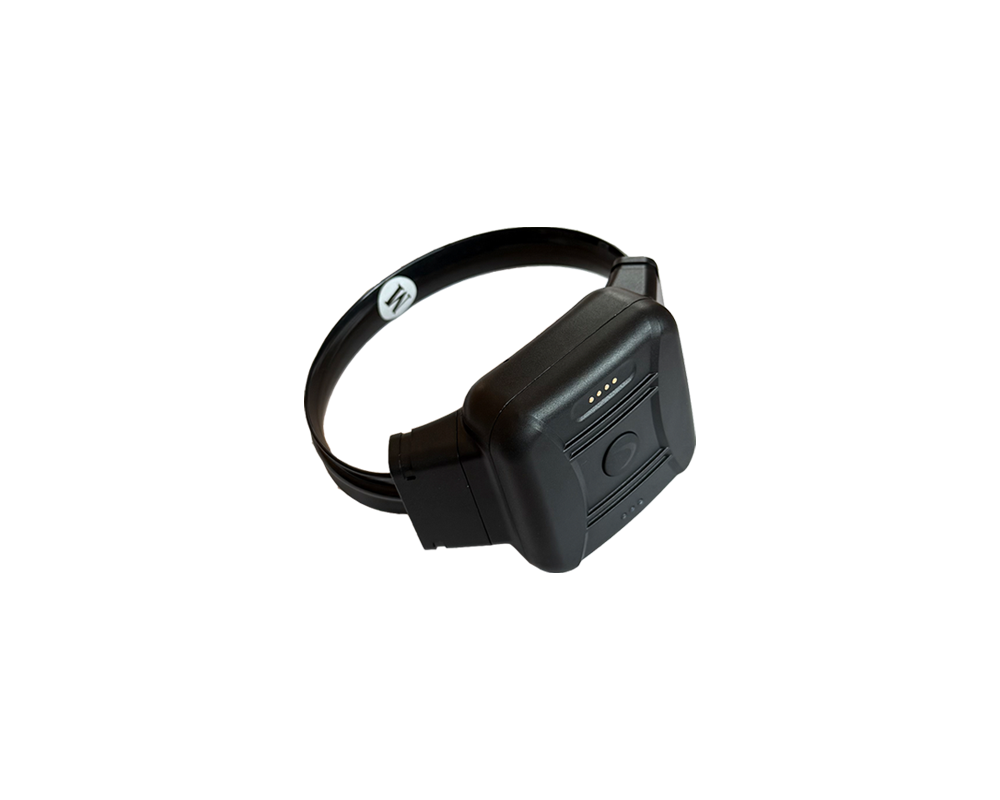
Full technical detail: CO-EYE ONE — GPS ankle monitor product overview.
Deployment checklist: from pilot to production
- Define the court packet: what reports a judge receives and how violations are described.
- Define escalation tiers: device troubleshooting vs true risk escalation.
- Pilot in your worst geography: rural edges, basement apartments, metal-clad workplaces.
- Instrument the pilot: alerts per user per week, median time-to-charge, continuity percentage.
- Train defendants: charging routines, water exposure, what to do if lights/alerts occur.
- Train staff for narrative discipline: how to speak to courts about uncertainty.
- Review contracts for hidden TCO: spare parts, swap fees, minimums, export limits.
FAQ
What is the difference between a consumer GPS tracker and bail-grade hardware?
Consumer trackers are not built for evidentiary workflows, tamper semantics, supervised enrollment, court reporting, and long-duration accountability. Bail-grade devices are designed around those operational requirements.
Should we prioritize "accuracy" or "continuity"?
For many bail programs, continuity and interpretability matter as much as centimeter-level maps. A hyper-accurate point that disappears for long stretches can be worse than a slightly coarser trace that remains logically consistent.
How do we avoid buying equipment that looks good in demos but fails in real counties?
Put the framework table in your contract conversation, run a geographically honest pilot, and refuse to generalize from cherry-picked routes. Demand alert-volume benchmarks and swap logistics.
Conclusion: buy the workflow, not the brochure
The best GPS ankle bracelet for bail bonds is the device your defendants can keep compliant, your staff can defend under scrutiny, and your economics can sustain. Use the scorecard, run an honest pilot, and force every vendor claim into a metric.
Ready to evaluate equipment for your program?
If you are standardizing bail bond GPS monitoring equipment across your network, start with a structured pilot and a written scoring rubric.
Contact Sales